How an Infrared Touch Frame "Sees" Your Finger
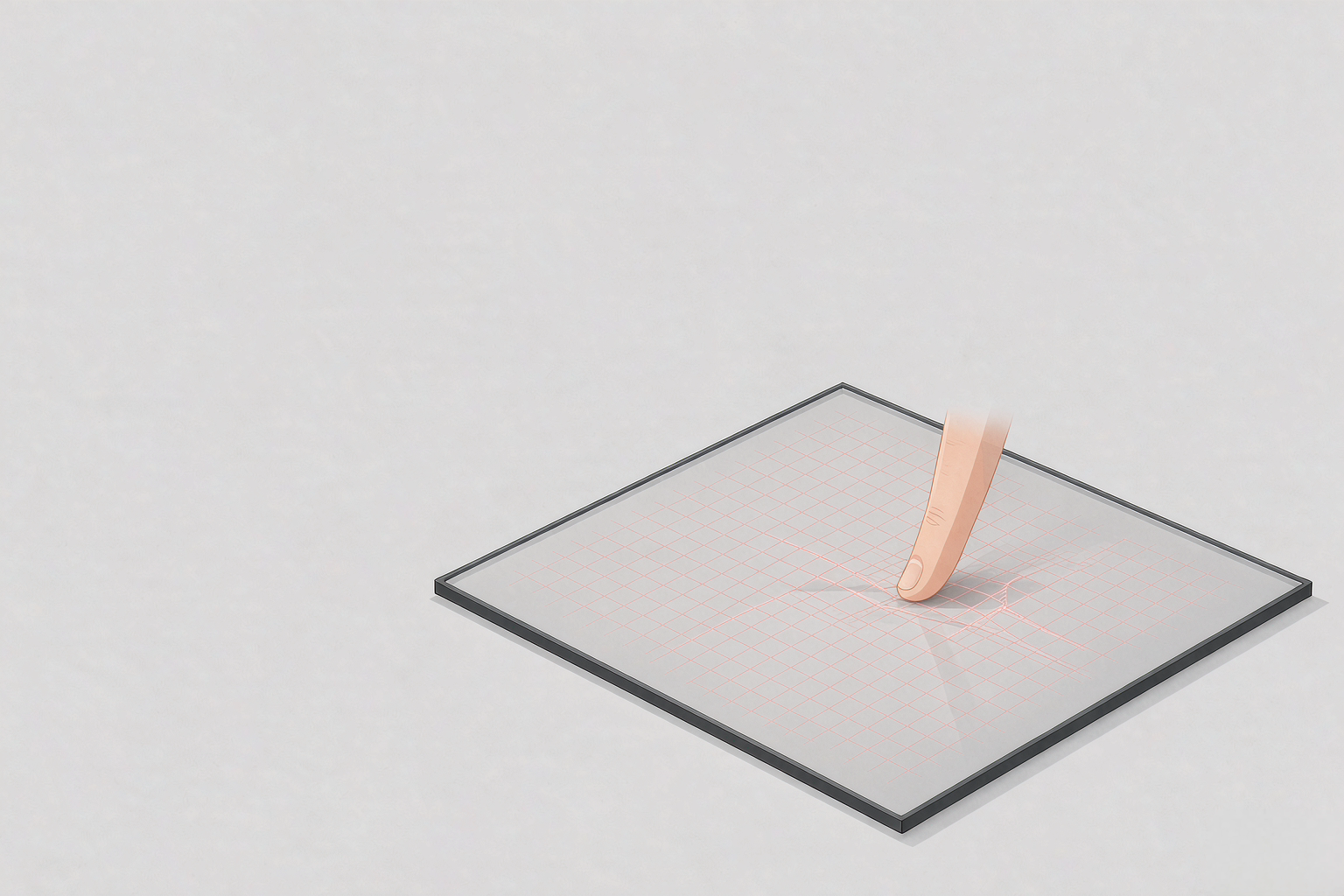
An infrared touch frame doesn't sense your body. It stretches an invisible net of light across the screen and counts which threads your finger breaks.
Most people think a touchscreen senses them. An infrared touch frame does something simpler: it stretches
an invisible net of light across the screen and counts which threads your finger breaks.
It doesn't know who you are. Capacitive screens detect your body's charge, which is why gloves defeat them.
An IR frame asks only: is something opaque blocking the light? Gloves, a stylus, a gloved hand holding a pen
— all register.
The net: LEDs line the top and left of the frame, detectors the bottom and right. Vertical beams locate X, horizontal beams locate Y, weaving a grid a few millimetres above the glass. Your finger never touches it
— it interrupts it.
Three steps give a coordinate: light each LED in turn so every detector knows its emitter; flag beams below threshold; take the centre where broken vertical and horizontal beams intersect. Since the whole grid scans at
once, separate clusters track simultaneously — multi-touch, up to 20 points on LMENGER frames.
Bigger is cheaper, counter-intuitively: capacitive cost scales with area, IR with perimeter — 32" to 86" triples the perimeter while area
grows sevenfold.
What it fears is anything disturbing the light path — sunlight, dust, insects, condensation — answered by
sealed IP65 housings.